Auxiliary Adjective (な) (Basic ㊦ 410)
An auxiliary adjective which indicates that what is expressed by the preceding sentence is the speaker’s conjecture concerning an event in the future or the present state of someone or something, based on what the speaker sees or feels.
Equivalent: Look; look like; appear; seem; feel like
| (i) Vます | そうだ | |
| 話しそうだ | It looks like someone will talk | |
| 食べそうだ | It looks like someone will eat | |
| (ii) Adjective い/な stem | そうだ | |
| 高そうだ | Something looks expensive | |
| 静かそうだ | Something looks quiet |
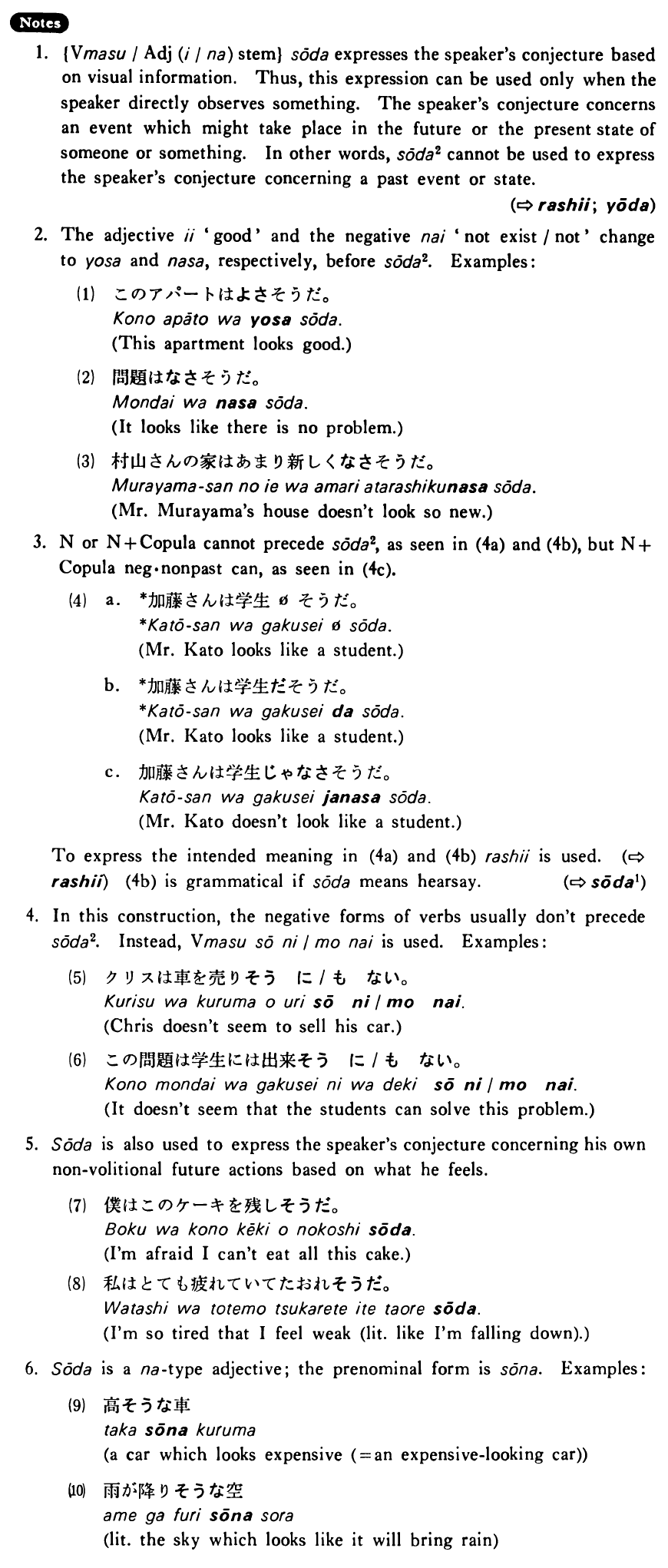
1. {Verbます/Adjective(い/な)stem} そうだ expresses the speaker's conjecture based on visual information. Thus, this expression can be used only when the speaker directly observes something. The speaker's conjecture concerns an event which might take place in the future or the present state of someone or something. In other words, そうだ2 cannot be used to express the speaker's conjecture concerning a past event or state.
2. The adjective いい 'good' and the negative ない 'not exist/not' change to よそ and なさ, respectively, before そうだ2. Examples:
(1)3. Noun or Noun+Copula cannot precede そうだ2, as seen in (4a) and (4b), but Noun+Copula negative nonpast can, as seen in (4c).
To express the intended meaning in (4a) and (4b) らしい is used.
(⇨ らしい)
(4b) is grammatical if そうだ means hearsay.
(⇨ そうだ1)
4. In this construction, the negative forms of verbs usually don't precede そうだ2. Instead, Verbますそうに/もない is used. Examples:
5. そうだ is also used to express the speaker's conjecture concerning his own non-volitional future actions based on what he feels.
6. そうだ is a な type adjective; the prenominal form is そうな. Examples: